Posts

Showing posts with the label space-time

Membrane of Life

Image
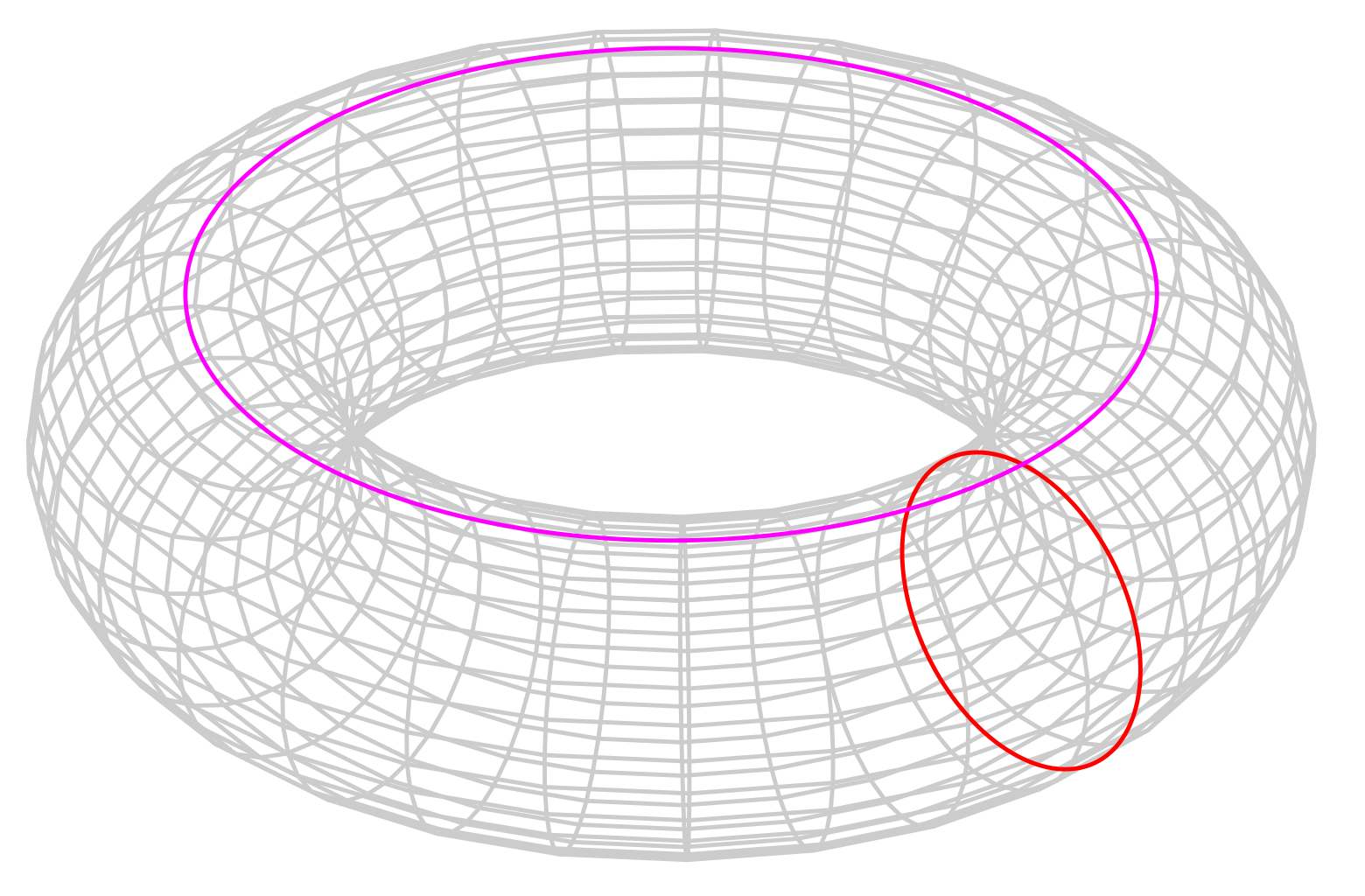
Perhaps a long time ago everything that exists in the universe was united together. At least that's what the big bang theory suggests. At the same time, our universe is characterized by a dichotomy. I think this dualism [1] creates opposites like left/right, this side/next side, light/dark etc. through an apparent separation. If one dispenses with one of the dimensions of the room, one gets a surface with a front and a back like a sheet of paper, which forms a torus ring on the left and right as well as on top and bottom. Its surface is finite but unlimited and curved (almost how the universe presents itself to us) [2, 3]. The front and back of the original surface now form the inside and outer surface of the ring. In principle, this also means that the entire three-dimensional space resp. splitting our four-dimensional space-time, and therefore everything that exists within it, in half (hence duality). But let's stay with the areas. If one postulates that one of the two sides ...

Everything in perspective?

One approach to unifying the four physical forces is Quantum Gravity (QG) [1], which attempts to combine General Relativity (GRT) and Quantum Field Theory (QFT). So far, this has not been possible because space-time would diverge in the center of a black hole. The problem could perhaps be solved geometrically. If "the singularity" were modeled e.g. as a torus ring [2], then there would not be an infinite density. Another approach might be not to first look behind the curtain of an event horizon, i.e. the standardization would then have to be fully valid "only" up to the event horizon. Due to the theory of relativity, the state of how the universe appears to us optically depends on perspective. Very close to an event horizon, to outsiders, time practically stands still for infalling objects, and so they never fall into it. Perhaps the starry sky seems so static to us mainly because time seems to pass so slowly "everywhere". It looks like the entire firmamen...

Singularity

The general theory of relativity predicts that a so-called "singularity" is hidden in a black hole (i.e. behind an event horizon). A thought experiment from school physics: A space capsule is on the moon. The astronauts want to teach back to earth. To do this, they have to overcome the moon's gravitational field. If they only had a catapult instead of a rocket drive, this would have to throw the space capsule into space at a certain speed so that it does not fall back onto the moon. Escape speed This speed can be calculated solely from the mass of the object to be left and its radius (position of the space capsule on the surface). For the moon it is: 2.3 km/s. If the astronauts not only want to leave the moon, but also our solar system via catapult, the escape speed is 42.1 km/s, and for our galaxy: 320 km/s. In order to leave our universe, however, our atronauts would have to be faster than light. However, since physics does not allow mass to ever move faster t...

Space-time – simply explained

We know from the Big Bang that a substantial proportion of matter in our universe was created within a very short time.  However, an equally large proportion of antimatter is required for the formation of matter.  So far, however, no substantial amount of this antimatter has been found anywhere. Where did the antimatter go? The famous physicist and Nobel Prize winner Richard Feynmann once put forward the thesis that the creation and merging of two antiparticles is nothing other than that one and the same particle reverses in time (and converts light into matter or vice versa). In my opinion, the creation of matter and antinatter in the Big Bang somehow took place "directed".  The antimatter was therefore thrown 180 ° away from us and is therefore inaccessible to us in space-time. I am therefore convinced that the matter in my body once again exists as antimatter and only therefore exists at all. Complex numbers as an analogy There is a suitable analogy in mathematics: the...

Black Holes etc.

Why is there a need for a string theory that tries to unify all physical forces in a single theory? Has the theory of relativity, for example, already been researched and understood so well that one can already try to attempt unifying theories based on it? Regardless of whether our current idea of the origin of our universe or of black holes is correct, one can still accept these vague structures as the best working hypothesis currently available. It is actually obvious that there must be a connection between the Big Bang and black holes – one as the antithesis of the other. The former is light, the latter rather dark – at least from our point of view. Where is the synthesis? In the creation of both, there is talk of an unimaginable amount of energy, which is said to have been concentrated in a very small space, so that the word "singularity" is even used in this context (although one would rather and perhaps should avoid this). So we prefer to jump from the point in time of ...